When should I have my child’s hearing checked? A milestone-by-milestone guide from newborn to Grade R.
Most parents remember the newborn hearing screening. That little probe in the ear, the beep, the tick on the form. All clear. Move on.
But hearing isn’t a once-off checkbox. A child can pass their newborn screen and still develop hearing difficulties later — from ear infections, fluid build-up, illness, medication, or causes that simply weren’t present at birth. And because young children can’t tell you what they’re missing, the signs are easy to overlook until they start showing up as something else: a speech delay, trouble at school, behaviour that looks like defiance but is actually confusion.
This guide walks through what to listen for at each stage — and when it’s worth picking up the phone.
Newborn to 3 months
What you should see:
Your baby startles at loud sounds. They quieten or smile when you speak. They seem to recognise your voice and calm down when they hear it. By about two months, they start making soft cooing sounds — not words, just little vowel-like noises that mean the auditory system is waking up.
If your baby doesn’t flinch at a door slamming, doesn’t seem soothed by your voice, or is unusually quiet compared to other newborns you’ve been around — that’s worth mentioning at your next paediatrician visit. It may be nothing. It may be fluid from delivery that hasn’t cleared. But it’s always better to ask early.
Every baby born in a South African hospital should receive a newborn hearing screening before discharge. If yours didn’t, or if the result was “refer,” don’t let that slip through the cracks. A diagnostic ABR (auditory brainstem response) test can be done within the first few weeks and gives a much clearer picture.
3 to 6 months
What you should see:
Your baby starts turning their head toward sounds. They notice music. They respond to changes in your tone — a playful voice gets a smile, a firm voice gets a pause. Babbling begins: repeated consonant-vowel combinations like “ba-ba” or “ma-ma,” though they don’t mean anything yet.
The red flag here is a baby who doesn’t turn toward sound at all, or whose babbling hasn’t started by six months. Some babies are just quieter than others, and that’s fine. But if you’re combining “quiet baby” with “doesn’t seem to notice when I walk into the room talking” — trust that instinct.
6 to 12 months
What you should see:
Babbling gets more complex. You’ll hear strings of sounds that almost sound like sentences, with rising and falling intonation. Your baby responds to their name. They understand “no” (even if they ignore it). They start pointing at things and looking where you point.
This is also the age when ear infections become common. A single ear infection usually resolves without lasting impact. But repeated infections — three or more in six months — can cause fluid to sit behind the eardrum for weeks at a time, muffling sound during a critical window for language development. If your child has had recurrent ear infections, ask your GP or ENT about a hearing check. Don’t wait for a speech delay to appear first.
12 to 18 months
What you should see:
First words arrive. “Mama,” “dada,” “ta” (a South African favourite), “no.” By 18 months, most children have somewhere between 10 and 50 words, though the range is wide. They follow simple instructions: “Give me the cup.” “Where’s your shoe?” They point at things they want and things they find interesting.
A child who isn’t using any words by 18 months, or who doesn’t seem to understand simple requests, should have their hearing tested. Not because something is necessarily wrong — late talkers exist, and many catch up beautifully — but because ruling out hearing loss is the single most important first step. If the ears are fine, you can relax a little and monitor. If they’re not, early intervention makes an enormous difference.
18 months to 2 years
What you should see:
Vocabulary grows fast. Two-word combinations start appearing: “more juice,” “daddy go,” “big dog.” Your child can follow two-step instructions: “Pick up the ball and bring it to me.” They enjoy being read to and can point to pictures in a book when you name them.
Watch for the child who seems to hear you sometimes but not others. This is often dismissed as selective listening (and sometimes it is — toddlers are world-class ignorers). But inconsistent responses to sound can also indicate fluctuating hearing loss from fluid behind the eardrums. If you find yourself saying “he hears me when he wants to” more than once a week, it’s worth getting a proper assessment rather than assuming it’s behaviour.
2 to 3 years
What you should see:
Sentences get longer. Strangers can understand about half of what your child says. They ask “why?” constantly. They can follow a conversation and take turns talking. They notice sounds in the environment — a plane overhead, a dog barking next door — and comment on them.
If your child’s speech is significantly harder to understand than their peers, or if they’ve stopped progressing after an initial burst of words, hearing should be checked. Speech sound errors are normal at this age (saying “wabbit” for “rabbit” is fine at two), but a child who drops the beginnings or ends of words consistently, or who speaks unusually loudly, may not be hearing the full picture.
3 to 4 years
What you should see:
Your child tells simple stories. They use sentences of four or five words. They understand concepts like “same” and “different,” “big” and “small.” They can hear you call from another room and respond. Most of what they say is understandable to people outside the family.
This is the age when many children enter a school or crèche environment for the first time, and teachers often pick up on things parents have normalised. If a teacher mentions that your child doesn’t follow group instructions, seems to “zone out” during circle time, or watches other children before acting — those are hearing red flags dressed up as attention problems. A hearing test takes thirty minutes and can save months of misdiagnosis.
4 to 5 years (Grade R)
What you should see:
Your child speaks in full, complex sentences. They can retell a story in order. They rhyme, they sing, they play with language. They hear and follow multi-step instructions in a noisy classroom. They’re starting to connect sounds with letters — the foundation of reading.
A child entering Grade R with an undetected mild hearing loss is at a real disadvantage. They may struggle with phonics, seem inattentive, fall behind in reading, or become withdrawn. These children are often labelled as “slow” or “not trying” when the real issue is that they’re missing 20 or 30 percent of what’s being said — especially in a classroom with background noise, which is all classrooms.
We’d recommend a hearing screening for every child before they start Grade R, whether or not there are concerns. Think of it like an eye test before school. You wouldn’t send a child into a classroom without checking they can see the board. The same logic applies to hearing.
When to skip the milestones and just book
Forget the age brackets. Book a hearing test now if:
- Your child had a complicated birth, was premature, or spent time in the NICU
- There’s a family history of childhood hearing loss
- Your child has had three or more ear infections in the past six months
- They’ve had meningitis, measles, or mumps
- They’ve been on ototoxic medication (your doctor will know)
- You just have a feeling something isn’t right
That last one matters more than people think. Parents notice things before tests do. If something feels off, it probably is — or at the very least, it deserves a proper look.
What a hearing test actually involves
Parents sometimes put off testing because they imagine something invasive or distressing. It isn’t.
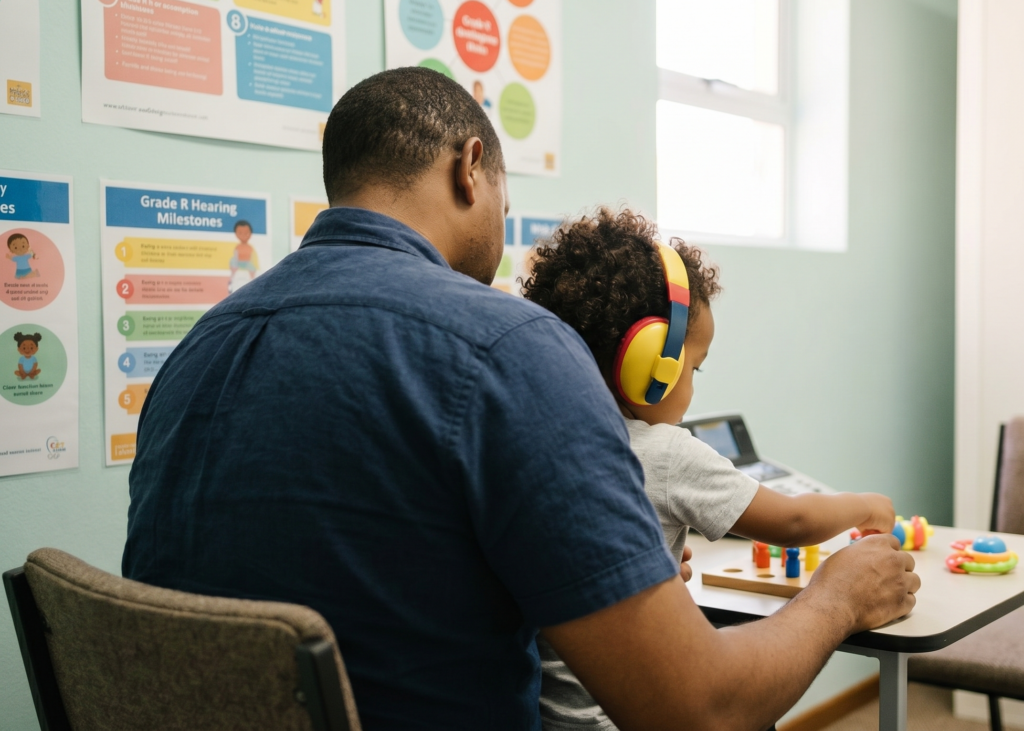
For babies and toddlers, we use OAE (otoacoustic emissions) or ABR testing — both are painless and can be done while the child sleeps or sits quietly. For children over about two and a half, we use play audiometry: the child listens for sounds through headphones and drops a block in a bucket or puts a peg in a board when they hear one. Most children think it’s a game. It takes about 20 to 30 minutes.
We also check the middle ear using tympanometry — a small probe that measures how the eardrum moves. This tells us whether there’s fluid or pressure behind the drum, which is the most common cause of temporary hearing loss in young children.
You walk out with a clear picture. Either everything is fine and you have peace of mind, or we’ve found something and can start addressing it immediately — which, at a young age, almost always leads to a good outcome.
The cost of waiting
Hearing loss in children isn’t usually dramatic. It’s not silence. It’s muffled. It’s missing the ends of words. It’s hearing the teacher when the room is quiet but losing her completely when the class gets noisy. It’s subtle enough that everyone assumes the child is fine — until they’re not.
The research is clear: children identified with hearing loss before six months of age, who receive appropriate intervention, develop language on par with their hearing peers. After six months, the gap widens. After two years, it’s much harder to close.
You don’t need a referral. You don’t need to wait for your child to fail at something first. You just need to call.