Ten tiny games that turn every car ride into language practice
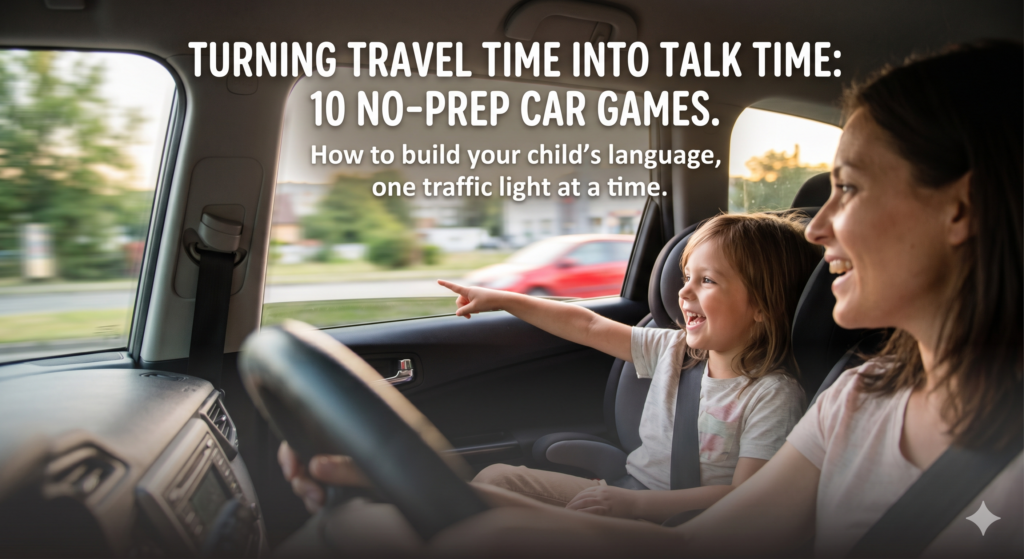
You are already spending the time. The car is already moving. The world outside the window is doing its thing. The only question is whether those twenty minutes between school and home are passing in silence — or quietly building your child’s language, one traffic light at a time.
These ten games require nothing. No preparation, no equipment, no internet connection. Just your voice, your child’s curiosity, and the ordinary world scrolling past the glass.
1. The Colour Hunt
Best for ages 2–5
Pick a colour before you pull out of the driveway. Every time your child spots something that colour — a car, a building, a person’s jacket — they call it out. You narrate back: “Yes! A red bakkie. And look — a red stop sign!”
Why it works: You are building vocabulary in context. The child is not learning the word “red” from a flashcard — they are learning it attached to real objects in the real world, which is exactly how language sticks.
2. What Am I?
Best for ages 3–7
Describe something you can see outside the window without naming it. “I am big and yellow. I carry lots of children. I stop at every school.” Your child guesses. Then swap — let them describe something to you.
Why it works: This game builds descriptive language, category knowledge, and the ability to hold information in working memory — all foundational skills for literacy and classroom learning.
3. The Story Round
Best for ages 4–8
You start a sentence: “Once upon a time there was a dog who could not find his bone…” Your child adds the next sentence. You add the next. Keep going until you arrive. The sillier, the better.
Why it works: Collaborative storytelling develops narrative language — the ability to sequence events, use connective words like then, because, and but, and maintain a topic over time. These are the same skills children need to retell a story in Grade 1.
4. More Than One
Best for ages 3–6
You say a word. Your child says the plural. One cat… two cats. One bus… two buses. One sheep… two sheep. When they get a tricky one, celebrate the confusion — “Ha! That one’s sneaky, isn’t it?”
Why it works: Morphological awareness — understanding how words change form — is a strong predictor of later reading ability. And it is genuinely fun when you hit the irregular ones.
5. Because, So, But
Best for ages 5–9
Give your child the start of a sentence and a connecting word. “The boy was late for school… because…” or “She was scared of the storm… but…” They finish it. Then you try one.
Why it works: Causal and contrastive connectives are some of the hardest language structures for children to master — and some of the most important for academic writing. Practising them aloud, without any pressure, is ideal.
6. Opposite Day
Best for ages 3–6
Call out a word and ask for the opposite. Start easy — hot, big, fast — and work toward trickier ones — kind, brave, empty. When they are ready, flip it: they give you the word, you give the opposite.
Why it works: Antonym knowledge deepens word understanding. A child who knows what generous means understands it better when they also know its opposite. Vocabulary breadth and depth are both important.
7. I Went to the Shop
Best for ages 4–8
The classic memory chain game. “I went to the shop and I bought… an apple.” Each person adds one item and repeats the whole list. Try to keep going until someone forgets.
Why it works: This is working memory and verbal rehearsal practice disguised as a game. For children who struggle with following multi-step instructions, this kind of repetition is genuinely therapeutic — and it does not feel like work at all.
8. How Are They the Same?
Best for ages 5–9
Pick two things you can both see, or two things from memory. “How are a taxi and a train the same?” Push for more than one answer. Then ask: “How are they different?”
Why it works: Comparing and contrasting requires category thinking, flexible vocabulary, and the ability to analyse rather than just name. These are higher-order language skills that do not always get enough practice in everyday conversation.
9. Feelings Check-in
Best for all ages
This one is the simplest and perhaps the most valuable. “Tell me one word for how you are feeling right now.” Not fine. Not okay. One real word. Then you share yours.
Build up a shared vocabulary over time — frustrated, relieved, proud, nervous, calm, overwhelmed. When a child has words for their feelings, they are far better equipped to communicate their needs, navigate conflict, and regulate their emotions.
Why it works: Emotional vocabulary is language too. And the car — where you are side by side rather than face to face — is often where children talk most honestly.
10. The Question Game
Best for ages 5–10
You answer only in questions. Your child answers only in questions. “Are we nearly there?” / “Do you think we are nearly there?” / “Why would I ask if I already knew?” It is harder than it sounds and dissolves into laughter within about ninety seconds.
Why it works: Formulating questions requires the speaker to think about what the listener knows, what information is missing, and how to structure a sentence to seek that information. It builds theory of mind and complex syntax at the same time.
A note from the practice
None of these games will replace therapy if your child needs it. But all of them will complement it — and for children who do not need intervention, they are simply good language nutrition.
If you are worried about your child’s speech or language development, the best first step is always a conversation. We offer a free 20-minute phone call for exactly that reason — no pressure, no forms, just a chance to talk it through with someone who has been doing this for over two decades.